Campbell earns 2026 DARPA Young Faculty Award
10-13-2026
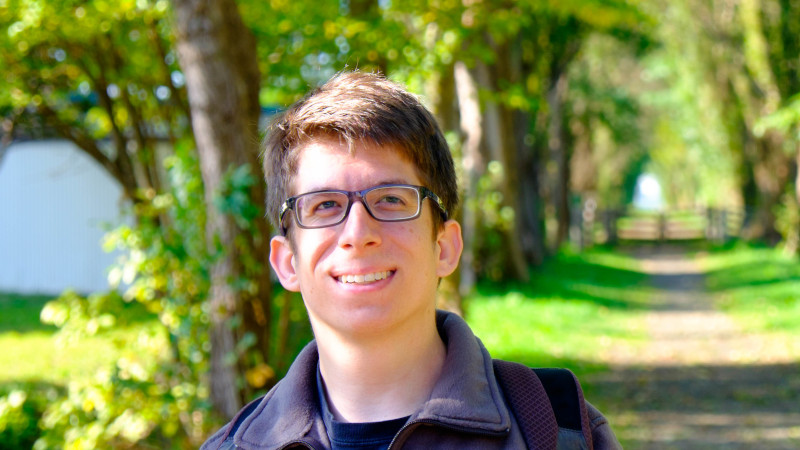
Joseph Campbell, assistant professor of computer science at Purdue University.
Purdue University computer science Assistant Professor Joseph Campbell has received a Defense Advanced Research Projects Agency (DARPA) Young Faculty Award to develop a new approach for helping robots learn complex tasks more like people do.
His project, “Textbook-to-Task Ontological Grounding for Robotics (TUTOR),” aims to enable robots to combine information from human instructional materials, such as manuals, tutorials and videos, with hands-on experience to learn new skills more efficiently.
“People can learn how to perform a new task by reading a manual or watching a demonstration and then applying that knowledge through hands-on practice,” Campbell said. “TUTOR aims to give robots a similar ability, allowing them to use the wealth of instructional material created for people as a starting point for learning.”
Robots today often require large amounts of training data to learn new tasks, making it difficult and costly to deploy them in new environments. TUTOR will use human instructional materials to provide robots with structured knowledge about tasks, reducing the amount of trial-and-error and hands-on data needed to acquire new skills.
The system will also allow robots to generalize what they learn based on the function of objects and resources rather than simply their appearance. This could help robots adapt when the exact objects or resources they were trained with are unavailable.
The research will be conducted with Campbell’s Collaborative AI for Machines & People (CAMP) Lab, which develops self-improving agents, including robots. The lab’s research focuses on three areas: introspection, which enables agents to understand their own knowledge and capabilities; sample-efficient learning, which helps agents learn with less data; and theory of mind, which explores how agents can understand the beliefs, intentions and goals of people and other agents.
“Systems like TUTOR could represent a paradigm shift in how we train and deploy robots and other autonomous systems,” Campbell said. “I’m excited to have the opportunity to work on this problem and to pursue this research with DARPA.”
The DARPA Young Faculty Award (YFA) program supports early-career researchers at U.S. academic and nonprofit institutions whose work aligns with national security needs. In addition to research funding, the program provides awardees with mentorship and connections to industry and national security organizations. Since its establishment in 2006, the program has supported more than 500 researchers nationwide.
About the Department of Computer Science at Purdue University
Founded in 1962, the Department of Computer Science was created to be an innovative base of knowledge in the emerging field of computing as the first degree-awarding program in the United States. The department continues to advance the computer science industry through research. U.S. News & World Report ranks the department No. 14 and No. 15 overall in undergraduate and graduate computer science, respectively. Graduates of the program are able to solve complex and challenging problems in many fields. Our consistent success in an ever-changing landscape is reflected in the record undergraduate enrollment, increased faculty hiring, innovative research projects, and the creation of new academic programs. Learn more at cs.purdue.edu.