From Pittsburgh to the pit lane: How CS student Anuj Shah turned a dorm room conversation into a motorsports career
04-08-2026
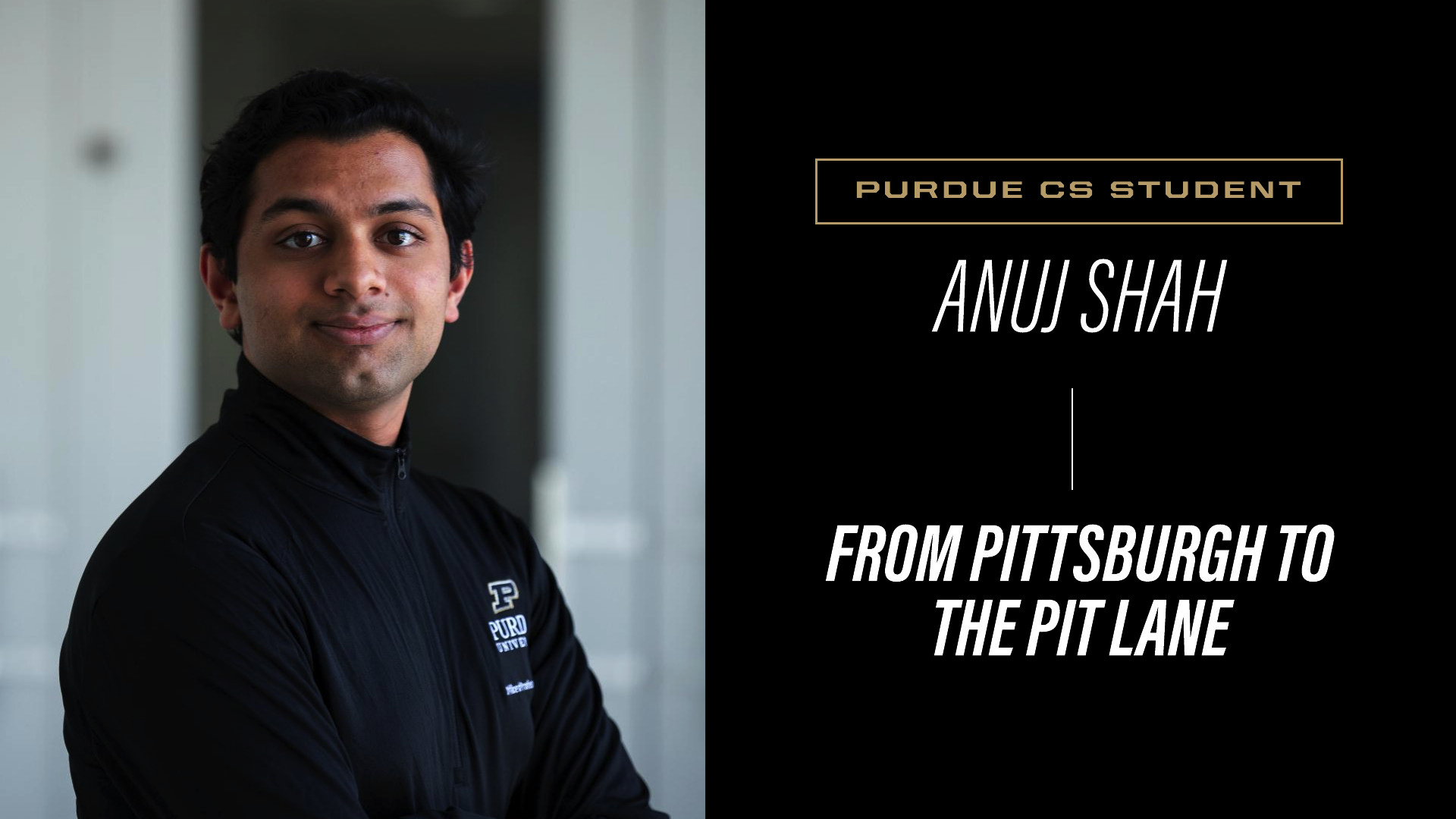
Anuj Shah, expected graduation 2027, CS major concentration in machine learning, studying computer science to build innovative programming for motorsports integration.
Every kid dreams about what they want to be when they grow up: an astronaut, a firefighter, a life-saving surgeon. But Anuj Shah, a computer science student in Indianapolis, knew only that he wanted to solve problems in a way that would continue to matter. Growing up in the suburbs of Pittsburgh, he had no single "lightbulb moment" that pointed him toward computer science. Instead, he remembers a constant urge to solve problems and make everyday life run more smoothly. As he watched computer science become the backbone of every major industry, Shah saw it as a way to stay relevant without boxing himself into a single path. What he didn't expect was that a chance encounter just a few doors down from his freshman dorm would steer him toward the dynamic world of professional motorsports.
That neighbor, who happened to be passionate about racing, became Shah's co-founder in the Road Racing Club at Purdue, a student organization dedicated to giving students hands-on experience with real cars. Through the club, Shah discovered the niche, technical challenges hiding within the motorsports industry and learned about motorsports software. He explains, “It was the perfect intersection: an exciting, fast-paced world paired with the chance to bring modern technology into spaces that often still rely on older tools."
Shah's journey from casual interest to professional involvement began with that co-founder, James McAlindon, who one night mentioned his previous work with a NASCAR team that relied on specific motorsports software. Those details stuck with Shah, and later that week he began reaching out to HH Development, the company that builds the race strategy and timing software standard in professional motorsports.
“Their software helps race teams make split-second decisions about pit stops, analyze carperformance in real time, and manage everything from tire strategy to setup data,” said Shah.
Impressed by the problems they were solving and confident his skills could contribute, Shah sent a cold email asking if they needed help over the summer. After several rounds of correspondence, they offered him an internship.
"It all started with a conversation in my dorm and a cold email," he reflects.
As a Machine Learning Product Engineer at HH Development this past summer, Shah worked on projects that supported both International Motor Sports Association (IMSA) as a sanctioning body and the racing teams competing under their technical regulations.
“One of my main projects involved analyzing hundreds of telemetry-derived performance metrics to figure out which key performance indicators were most closely tied to on-track advantage,” said Shah. “This work supported IMSA’s Balance of Performance, or BoP, process, which is how the series keeps competition fair by adjusting factors like horsepower, weight, and aerodynamics when one car is consistently outside the expected performance window. By using supervised learning techniques to find the metrics that best predicted performance outliers, I helped inform which technical adjustments the sanctioning body might consider when a particular platform was too strong or too weak.”
The highlight of Shah's summer came during the IMSA Battle on the Bricks at the Indianapolis Motor Speedway (IMS). Although developers don’t normally get the opportunity to attend live-action events, since the race was local at IMS, Shah secured a pass and attended. This was his first time seeing HH’s software running in a live race environment across dozens of pit boxes during a six-hour endurance race. His HH credentials gave him backstage-style access to areas most fans never see: garages, pit lane, and team operations up close.
"Writing code and building features at your desk is one thing," Shah said. "Watching my team’s work drive real-time decisions for professional teams is something entirely different."
But the Battle on the Bricks offered Shah more than just the thrill of seeing his work in action. During one of the qualifying sessions, he struck up a conversation with a race engineer from another team. They discussed how HH's software supports teams and Shah's interest in data and machine learning within motorsports. By the end of that conversation, the engineer encouraged Shah to reach out about potential opportunities. Shah followed up after the event, and that connection led to his current role as an ML Data Engineer with Team ACP Racing.

Anuj Shah at the Indianapolis Motor Speedway, Summer 2025.
Now concentrating in machine learning with a tentative management minor and expected graduation in 2027, Shah has pushed deeper into his field by taking a graduate-level statistics courses. As a teaching assistant for CS 190, Professional Practice in Computer Science, Shah lectures each semester on spontaneous networking, emphasizing that success increasingly depends not just on what you know, but who you know and how you show up in those interactions.
His advice to future computer science students is simple: "As Purdue students, we have the advantage of a strong name that can open doors that might otherwise stay closed. Use that thoughtfully. Be friendly and genuine, be curious, and actually want to learn from the people you talk to. Reach out to alumni, attend events, follow up with speakers, and send cold emails when you discover a company doing interesting work."
Shah’s journey as a naïve freshman trying to find his way to a machine learning engineer developing cutting-edge technology proves that curiosity and collaboration can lead you down paths you never knew existed. "I've only scratched the surface, and that's exciting," Shah said. "A strong foundation in machine learning gives me a way to tackle complex and data-heavy problems in industries I care about—and ultimately, that's what motivates me."
About the Department of Computer Science at Purdue University
Founded in 1962, the Department of Computer Science was created to be an innovative base of knowledge in the emerging field of computing as the first degree-awarding program in the United States. The department continues to advance the computer science industry through research. U.S. News & World Report ranks the department No. 16 and No. 19 overall in undergraduate and graduate computer science, respectively. Graduates of the program are able to solve complex and challenging problems in many fields. Our consistent success in an ever-changing landscape is reflected in the record undergraduate enrollment, increased faculty hiring, innovative research projects, and the creation of new academic programs. Learn more at cs.purdue.edu.
Written by: Alison Harmeson, senior communications specialist for the Purdue University College of Science
Contributor: Anuj Shah, Purdue Computer Science student