Purdue Computer Science research featured on cover of Communications of the ACM
04-07-2026
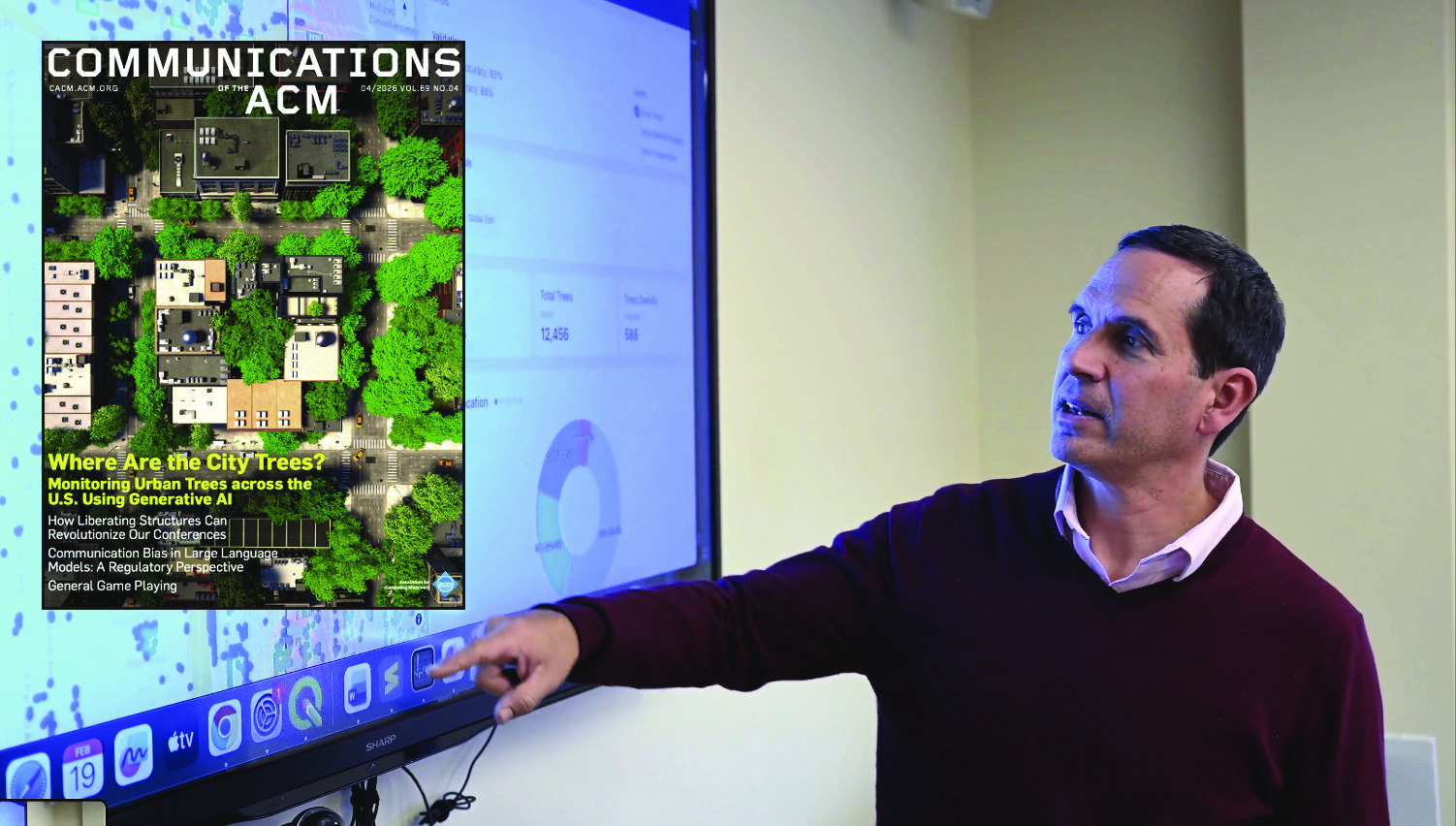
Purdue University’s Department of Computer Science has been recognized on a global stage, with research led by computer scientists and collaborators from the Institute for Digital Forestry. Their recent work is featured as the cover story of the April 2026 issue of Communications of the ACM, the flagship publication of the Association for Computing Machinery.
The article, authored by Adnan Firoze, Akshaj Uppala, Lindsay Darling, Raymond A. Yeh, Bedrich Benes, Brady Hardiman, Songlin Fei and Daniel G. Aliaga, highlights innovative work in urban visual computing, an interdisciplinary field that combines computer graphics, computer vision, and artificial intelligence to model and better understand complex real-world urban environments.
Modeling cities and beyond
The work used AI with satellite imagery to map millions of trees across U.S. cities, a task that previously required tens of thousands of volunteer hours by hand. This new AI-enhanced visual computing system can analyze entire urban forests in about a day, offering fast, precise insights for climate resilience, wildfire response and equity in green space access. It has identified roughly 280 million trees in more than 330 U.S. cities.
Aliaga and team are developing computational approaches that capture both the visual structure and dynamic behavior of large-scale environments, from urban landscapes to natural ecosystems.
By integrating diverse data sources, including aerial imagery, geographic data, and environmental inputs, their work enables the creation of highly detailed, scalable models of cities and landscapes. These models support simulation and analysis, allowing researchers to explore how environments evolve and respond to change.
“Our goal is to create models that don’t just look realistic, but that help us understand how complex environments function and change over time,” said Aliaga, associate professor of computer science. “By combining visual computing with data-driven methods, we can begin to answer important questions about the future of our cities and natural systems.”
Bridging urban computing and digital forestry
This work is closely connected to Purdue’s Institute for Digital Forestry, which brings together researchers across disciplines to apply AI, remote sensing, and large-scale data analysis to environmental and forestry challenges.
Contributors to the project, including experts in forestry and environmental science, help extend the research beyond urban environments to better understand ecosystems, vegetation, and land use at scale. This integration enables a more holistic view of how built and natural systems interact, an increasingly important challenge in the face of climate change and rapid urbanization.
From data to decision-making
The impact of this research extends across a wide range of applications, including:
- Urban planning and infrastructure design
- Environmental monitoring and sustainability
- Ecosystem and forestry analysis
By transforming complex datasets into actionable models, the team’s work supports more informed decision-making and enables “what-if” scenario testing for real-world challenges.
Watch: Bringing urban and environmental modeling to life
Watch this video produced by the CACM.
About the Department of Computer Science at Purdue University
Founded in 1962, the Department of Computer Science was created to be an innovative base of knowledge in the emerging field of computing as the first degree-awarding program in the United States. The department continues to advance the computer science industry through research. U.S. News & World Report ranks the department No. 16 and No. 19 overall in undergraduate and graduate computer science, respectively. Graduates of the program are able to solve complex and challenging problems in many fields. Our consistent success in an ever-changing landscape is reflected in the record undergraduate enrollment, increased faculty hiring, innovative research projects, and the creation of new academic programs. Learn more at cs.purdue.edu.